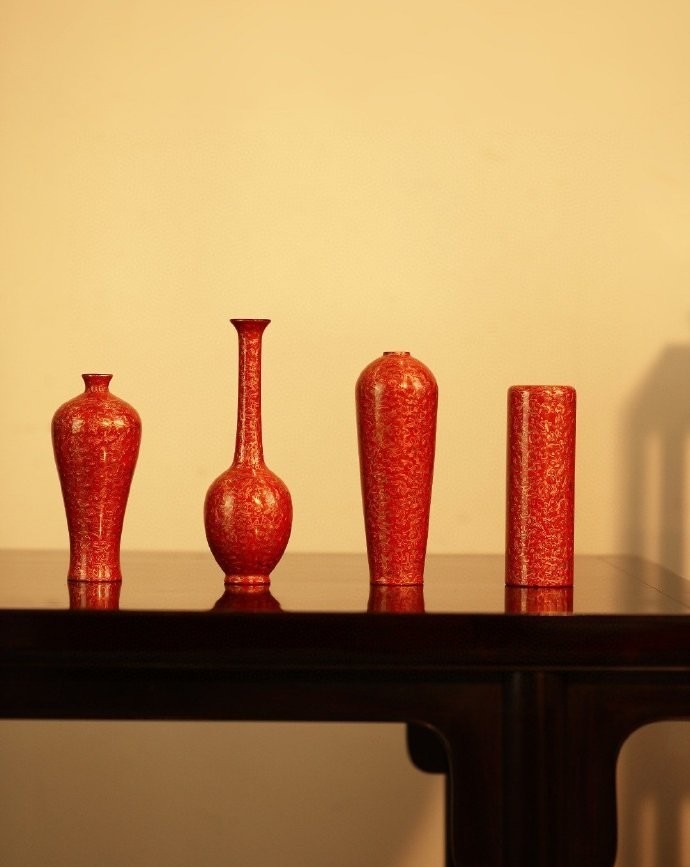
East Asian lacquer, known for its exquisite beauty and durability, is a time-honored craft primarily using sap from the Toxicodendron vernicifluumtree. This natural polymer hardens into a lustrous, protective coating that has been used for millennia in China, Japan, Korea, and other regions.
Historical Significance
Origins: Evidence of lacquer use in China dates back to the Neolithic period (c. 5000 BCE).
Cultural Exchange: Techniques spread along the Silk Road, influencing Japanese, Korean, and Vietnamese traditions.
Symbolism: Often adorned with motifs representing longevity, fortune, and nature, lacquerware has been used in rituals, as imperial gifts, and in daily life.
The Craft Process
Harvesting Lacquer Sap
Carefully tapped from lacquer trees, much like rubber.
Raw sap is filtered to remove impurities.
Base Preparation
Substrates (wood, bamboo, cloth, or metal) are meticulously shaped and smoothed.
Multiple layers of hemp cloth or paper may be applied with lacquer to strengthen the body.
Applying Lacquer
Thin coats are brushed on, with each layer requiring drying in a humid chamber (furo).
Dozens of layers can be applied for high-quality pieces, with polishing between coats.
Decoration Techniques
Carving: Incising designs into hardened lacquer (e.g., Chinese diaotian).
Inlaying: Embedding mother-of-pearl, gold, silver, or other materials (e.g., Japanese raden).
Painting: Using colored lacquers or gold/silver powder (e.g., Japanese maki-e).
Polishing: Revealing underlying decorative layers through careful abrasion.
Iconic Traditions
China: Carved lacquer (diaotian), lacquer paintings.
Japan: Maki-e(sprinkled picture), raden(shell inlay), Negoro-nuri(two-toned ware).
Korea: Ottchillacquer, often inlaid with mother-of-pearl.
Vietnam: Son mai lacquer paintings, known for deep, luminous colors.
Care and Preservation
Handling: Hold with clean hands; avoid touching decorated surfaces excessively.
Cleaning: Dust with a soft, dry cloth. For gentle cleaning, use a slightly damp cloth and dry immediately. Avoid chemicals or abrasives.
Environmental Conditions:
Avoid extreme temperatures, humidity, and direct sunlight, which can cause cracking or fading.
Maintain stable humidity (around 50-55%).
Usage: While durable, avoid exposure to harsh chemicals, alcohol, or excessive heat. Not typically microwave or dishwasher safe.
Storage: Wrap in acid-free tissue paper and store in a stable environment. Allow air circulation.
Conservation
Professional Restoration: For valuable or antique pieces, consult a specialist. Improper repairs can diminish value and integrity.
Documentation: Keep records of the item’s history, which aids in preservation and appreciation.
Contemporary Relevance
Modern artisans continue these traditions while experimenting with new forms and applications. Lacquer’s sustainability (as a natural resin) and aesthetic appeal keep it relevant in art, design, and luxury objects.
Conclusion
East Asian lacquer is a testament to human ingenuity—transforming a natural sap into objects of enduring function and profound beauty. Its care requires an understanding of its organic nature, ensuring these treasures endure for generations.